Trumps at MMP

Mouth Resonated Instruments & Products
Mouth Music Press - PO Box 6444 Boise, ID 83707

Home Feedback Order Form

PO Box 6444 Boise, ID. 83707 USA
Credit Card Order by Phone: 
208.841.8780

(Mon-Sat  10am-6pm  Pacific Time USA)

Trumps at MMP

jewsharp.com   /   mouthmusic.com

Home
Trumps
Mouthbows
Humanatone
Recordings
Publications
Clackamore
Piano Key Table
The OddTones

Order Form
Feedback
Audio Vault

Download the
Printable MMP
Order Form and
Instrument Information
Sheet (.doc, .rtf, .pdf)

Szilágyi Chancellor US$ 17
Szilágyi Chancellor
Back In Stock


Learn more about
Jew's Harps:
Support the
Jew's Harp Guild


YOU CAN LEARN TO PLAY

An amazing new musical instrument

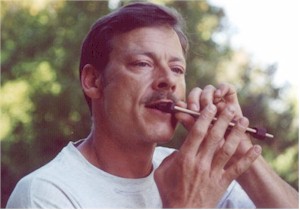
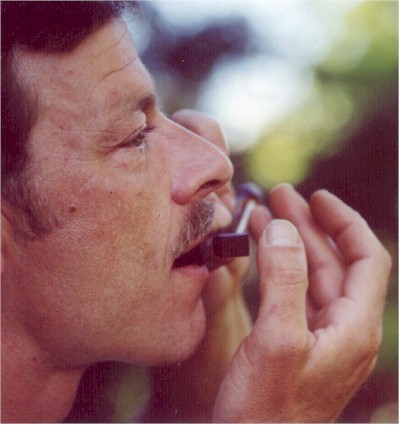
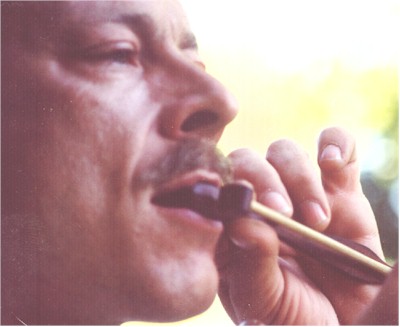
WAYLAND HARMAN - Playing his Clackamore

WAYLAND HARMAN
Playing the CLACKAMORE
(*turn on your sound*)

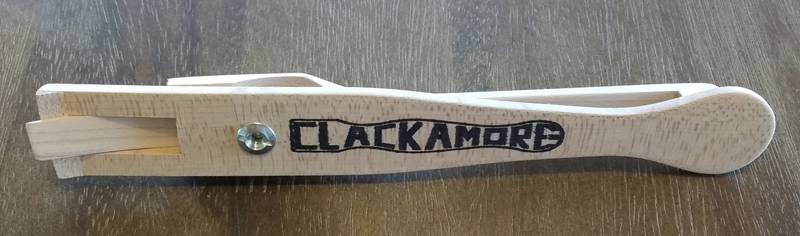
Standard Maple
(center of picture)
CLACKAMORE

ALL SOLD OUT!
NO LONGER BEING MADE

Clackamores- (top & bottom) Pro-Models, (mid) Standard Model

The pocket-sized CLACKAMORE is both a percussive and melody instrument.
It is easy to play - simply hold it to your lips and tap with your fingers.
This is all you need to do to play along and provide a percussive beat.
Anyone can join in jam sessions!

All musicians will enjoy the challenge of learning to play melodies with the CLACKAMORE. By forming the mouth into shapes akin to saying "E" and "O", and by opening and closing the throat, melodies from nursery rhymes to blue grass rifts can be played. The CLACKAMORE has been described as a "percussive jew's harp" and "a tool for listening to the shape of your mouth".

Audio Index
Listen to Soundclips of the CLACKAMORE
.MP3 Samples
Windows Media Audio Samples
.WAV Samples


More about the CLACKAMORE

"A TOOL FOR LISTENING TO THE SHAPE OF YOUR MOUTH", that's how Wayland Harman describes his Clackamore. This percussive musical instrument is capable of playing melodies by utilizing the player's mouth cavity.
Most people can be playing a Clackamore in 5 or 10 minutes compared to the many hours required to achieve beginner levels with most traditional instruments. "In spite of its simplicity, folks tell me a year later about the new sounds and rhythms they are finding. It's very exciting to get that kind of feedback, especially from kids", said Wayland.
Children are one focus of the Clackamore. Wayland hopes the instrument will serve as an introduction to music to generations of American youth. "The instruments to which our children are first exposed can be very rigid musically, which is fine when learning sight reading and preparing for classical instruments. The Clackamore, however, encourages music to be spontaneous. It brings out the hidden musician, instead of remolding the musician to fit current musical trends", explained Wayland.
Music is a universally accepted form of communication. "Cultural differences and enormous variations of style give us a lot to argue about, however, we all agree music is pretty good stuff", mused Wayland. "The Clackamore allows non-musicians to become participants where before they were only listeners", he continued.
Wayland quips, "Warning: Use of the Clackamore may lead to harder instruments!"

PLAYING YOUR CLACKAMORE
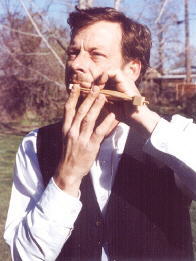
The Clackamore Hold the Clackamore as shown, resting your thumb and forefinger against your cheek while grasping opposing sides of the instrument neck. With the instrument lightly touching your lips, tap the reed with the extended fingers of your free hand. To play different notes, change the size and shape of your mouth cavity by silently mouthing the letter "A" and "E". With a little practice, these pitch variations can be controlled to permit the playing of melodies. Experimentation will reveal the many different sounds and rhythms you can play with your Clackamore.
Playing the ClackamoreHolding the Clackamore

Maintaining Your CLACKAMORE

Your Clackamore has been lightly coated with mineral oil. Additional application will keep it looking new. Should any rough spots develop, sand with fine grit paper (180 or finer) and reapply oil.
The hammer should occasionally be adjusted so that its contact point on the spoon is moved slightly. This will prevent a deep dent from developing on the spoon's back ridge. Do this by sliding the reed at the coupling block.
The action is the distance between the back of the spoon and the point of the hammer. This distance may require adjustment to accommodate your individual style of play. To make the instrument play with a lighter touch, wrap a rubber band around the narrows. To make the instrument play with a heavier touch, trim or sand the 2 faces of the hammer that form the point. The hammer and reed should be removed from the coupling block to perform this adjustment. Test your progress often to avoid removing too much material.

Prices and availability are subject to change without notice
Shipping and handling:
Domestic US$ 4.00 first item and US$ 2.00 each additional
International US$ 6.00 first item and US$ 2.00 each additional
(Idaho residents add 5% sales tax)


Home Feedback Order Form

Credit Card Order by Phone:  208 . 841 . 8780
MC - Visa - Discover
Mon-Sat  10am-6pm  Pacific Time USA

Pay by Check or Money Order:
Mouth Music Press  PO Box 6444
Boise, ID. 83707 USA

Learn more about
Jew's Harps

Jew's Harp Guild

• Home • Trumps • Mouthbows • Humanatone • Recordings • Publications • Clackamore • Piano Key Table • The OddTones •
Website Design by M.D. Poss      Partner -  Mouth Music Press
Last modified: August, 2008